At a glance
Lower Navarre is Nafarroa Beherea in Basque, literally ‘Navarre down below’. The name recalls that it is the northern part of the former Kingdom of Navarre, which remained out of reach of the 16th-century Castilian-Aragonese conquest and was cut off from Upper Navarre (Nafarroa). Its historic capitals are Saint-Jean-Pied-de-Port (Donibane Garazi) and Saint-Palais (Donapaleu), the latter becoming the kingdom’s main centre after 1512.
It has about 30,000 inhabitants. There is not a single large town, but rather a constellation of small towns and farms clinging to the valleys of the Nive and the Bidouze.
A little history
- 1512: the Kingdom of Navarre is conquered by Ferdinand II of Aragon (the Catholic). The south (Upper Navarre) remains under Spanish rule; the north reverts to the kings of Navarre.
- 1589: Henry III of Navarre becomes Henry IV of France. His successors bear the title ‘King of France and Navarre’.
- 1620: Louis XIII unites Lower Navarre (and Béarn) with the French Crown; the Navarrese institutions are merged with those of Béarn and transferred to Pau.
- 1789–1790: the Revolution abolishes privileges; the province is incorporated into the Basses-Pyrénées department.
- 19th–20th centuries: large-scale emigration to the Americas.
Must-see sights
- Saint-Jean-Pied-de-Port — the ramparts, the citadel above the town (remodelled to plans by Vauban), the Notre-Dame bridge over the Nive, and the Porte Saint-Jacques (St James’s Gate), where the Camino Francés (French Way) begins or ends.
- Saint-Étienne-de-Baïgorry — the so-called ‘Roman’ bridge (1661), the Château d’Etxauz, the terraced Irouléguy vineyards.
- The Aldudes valley — the Col d’Ispéguy (a pass on the border) and farms rearing Kintoa PDO (AOP) pigs.
- Irati forest — one of the largest beech and fir forests in Europe (about 17,000 ha straddling the border: Navarre on the Spanish side, Lower Navarre and Soule on the French side).
- Ibañeta Pass (just across the border, in Navarre) — a place associated with Roland and the Battle of Roncevaux Pass, with a chapel and views over the Pyrenees.
- Saint-Palais — former mint of the kings of Navarre, with the Gibraltar stele (marking where Camino routes meet) nearby, and a Basque strength sports festival in August.
- Ostabat — the place where, according to the 12th-century Pilgrim’s Guide, the Camino routes from Tours, Vézelay and Le Puy come together.
Main towns
- Saint-Jean-Pied-de-Port (Donibane Garazi) — the French gateway to the Camino, ramparts and the Nive
- Saint-Palais (Donapaleu) — former capital of Lower Navarre
- Saint-Étienne-de-Baïgorry (Baigorri) — Irouléguy wine and the Aldudes valley
- Iholdy (Iholdi) — the Iholdi-Ostibarre area
Must-try food and drink
- Irouléguy wine (PDO) — the only wine appellation in the French Basque Country (Iparralde), about 270 ha; grape varieties tannat, cabernet franc, cabernet sauvignon, petit courbu, gros and petit manseng; schist and sandstone soils
- Kintoa pork and ham (PDO) — from the Basque pig (porc pie noir du Pays basque), reared outdoors, notably in the Aldudes valley
- Ossau-Iraty cheese (PDO) — sheep’s milk, aged for at least 80 days (small cheeses) to 120 days (large cheeses)
Living traditions
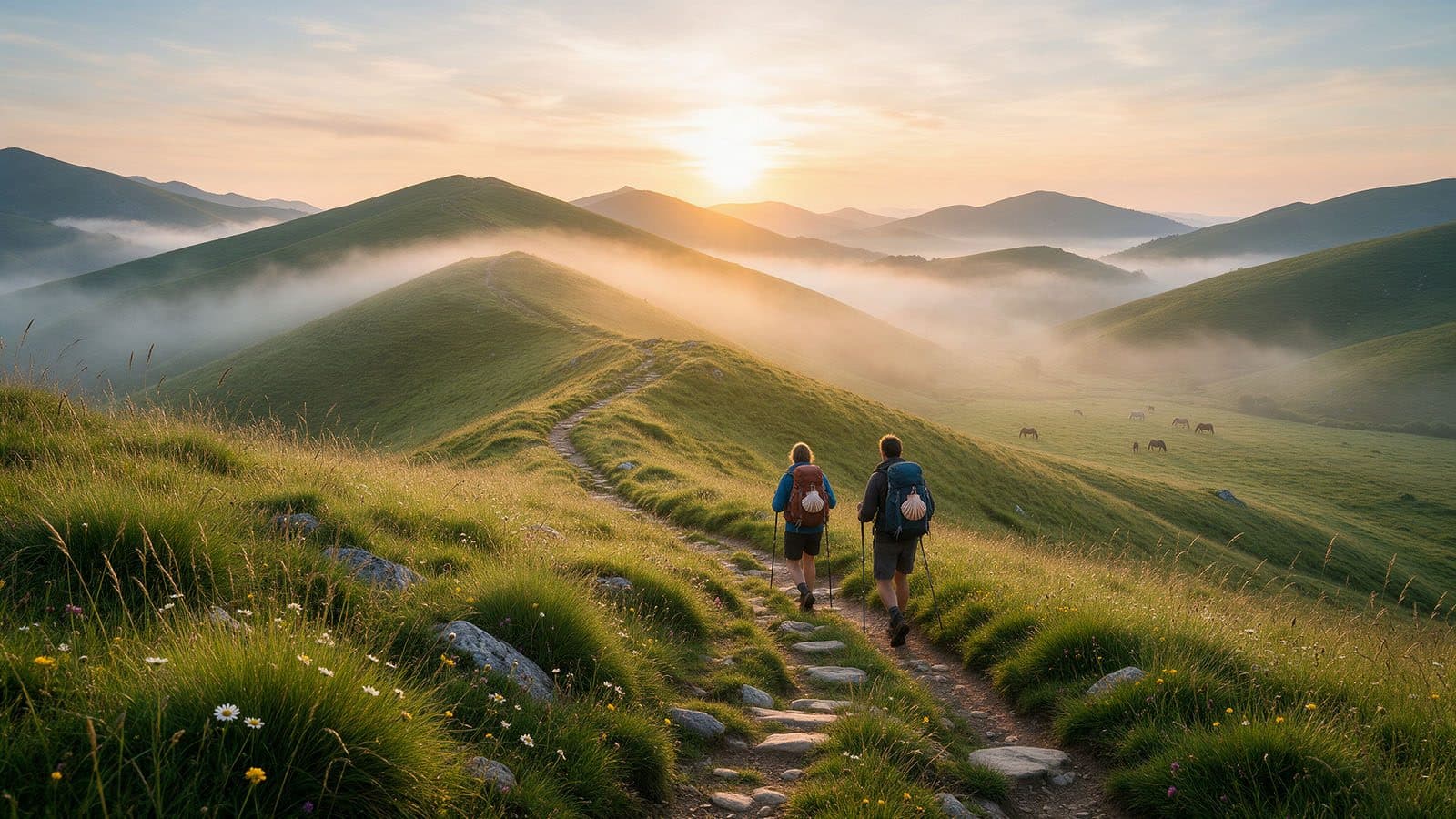
- The Camino Francés — about 55,000 pilgrims a year call in at the pilgrim office in Saint-Jean-Pied-de-Port before crossing the Pyrenees to Roncesvalles (about 25 km, more than 1,300 m of ascent via the Napoleon Route). A legendary stage of the Way.
- Basque strength sports — the Saint-Palais festival is one of the big events.
- Pastoralism — in summer, flocks of sheep move up to the high mountain pastures.
Curiosities and anecdotes
- The Basque pig almost died out in the 20th century. In 1989, farmers including Pierre Oteiza set up an association to save it: the herd grew from about 25 pigs to more than a thousand by 2000. Kintoa pork gained PDO status in 2017, and Kintoa ham in 2019.
- Roncesvalles (Orreaga), just across the border in Navarre: in 778 (most probably on 15 August), Charlemagne’s rearguard was wiped out there by the Vascones, and Roland was killed. In the 11th century, the Song of Roland replaced the Vascon attackers with ‘Saracens’. In Itxassou (Labourd), the Pas de Roland, a rock with a gap through it beside the Nive, bears his name.
Photographing Lower Navarre
- Irati forest in autumn — copper beeches, filtered light, a sea of clouds from the ridges
- Saint-Jean-Pied-de-Port in the early morning — mist on the Nive, ramparts above, pilgrims setting off
- Irouléguy vineyards in October — colourful terraces before the grape harvest
- Ibañeta Pass (Navarre side) — the view down towards Roncesvalles
- Aldudes valley — flocks, meadows, Basque pigs out in the open